


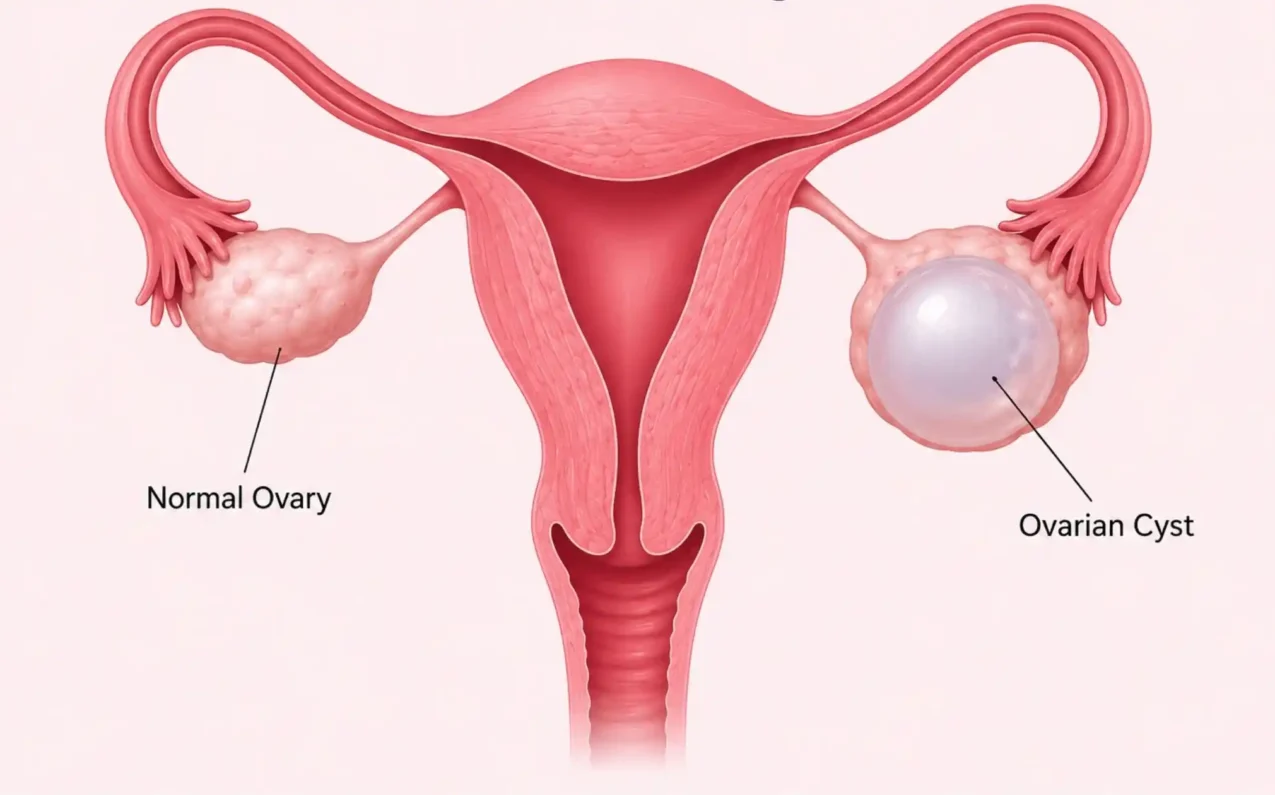
Hearing the words “ovarian cyst” can naturally make you worried. But in most cases, there is no reason to panic. An ovarian cyst is a fluid-filled sac that develops in or on an ovary, and ovarian cysts are quite common, particularly during the reproductive years.
In fact, many ovarian cysts cause no noticeable symptoms and disappear on their own within a few months. Some women only find out they have one during a routine ultrasound, while others may experience symptoms such as pelvic pain, bloating, or changes in their periods.
So, when does an ovarian cyst need attention, and when is simply monitoring it enough? Understanding the type of cyst, its symptoms, and how it is evaluated can help you know when it is time to speak with a gynaecologist.
What Is an Ovarian Cyst?
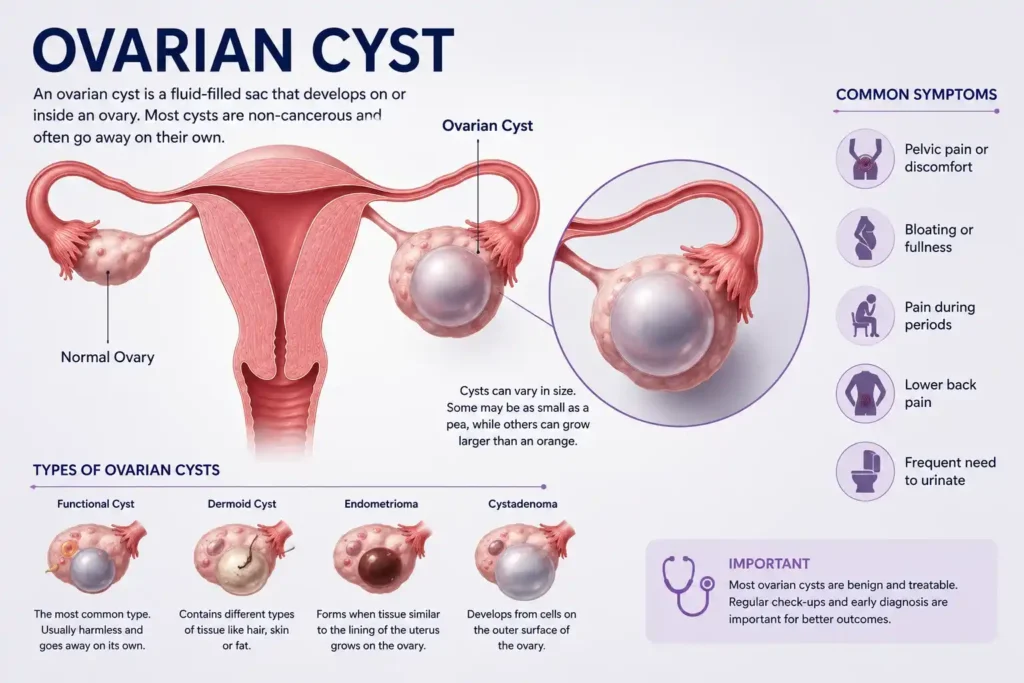
An ovarian cyst is a sac that forms inside an ovary or on its surface. It usually contains fluid. The ovaries are two small organs located on either side of the uterus. They play an important role in reproduction by releasing eggs and producing reproductive hormones.
Some ovarian cysts develop as a result of the natural processes that occur during the menstrual cycle. These are known as functional cysts. They are generally harmless and often disappear naturally within two or three menstrual cycles without requiring treatment.
It is also important to remember that an ovarian cyst does not automatically mean cancer. Most ovarian cysts are non-cancerous. However, the possibility of a cancerous cyst becomes more important to consider after menopause, which is why ovarian cysts found after menopause may require closer evaluation.
Depending on factors such as the cyst’s size, appearance, symptoms, age, and overall health, a doctor may recommend monitoring, medication, or surgery.
What Are the Different Types of Ovarian Cysts?
Not all ovarian cysts are the same. They can develop for different reasons and may require different approaches to treatment.
The most common type is a functional cyst, which develops as part of the normal menstrual cycle.
Functional ovarian cysts
Functional cysts are associated with ovulation. The two main types are:
- Follicular cyst: This occurs when a follicle does not release an egg and continues to grow.
- Corpus luteum cyst: This develops after ovulation when fluid collects inside the follicle that previously released the egg.
The good news is that most functional cysts disappear on their own without treatment.
Other ovarian cysts
There are also other types of ovarian cysts, including:
- Dermoid cysts: These are ovarian cysts that can develop with a variety of tissue types, including hair, skin, and teeth.
- Cystadenomas: These cysts originate from the cells that form the outer layer of the ovary.
- Endometriomas: These are associated with endometriosis and can develop when endometriosis-like tissue affects the ovary.
Knowing the type of cyst is important because each type can behave differently and may require a different treatment approach.
What Are the Symptoms of an Ovarian Cyst?
One of the tricky things about ovarian cysts is that they often cause no symptoms at all. You may not know you have one until it is noticed during an ultrasound examination.
Symptoms are more likely to occur when a cyst becomes large, ruptures, or causes the ovary to twist.
Common ovarian cyst symptoms can include:
- Discomfort or pain in the lower abdomen or pelvic area
- Pain that is mainly felt on one side
- Abdominal bloating or noticeable swelling
- A sense of fullness, heaviness, or pressure in the abdomen
- Pain during sexual intercourse
- Heavy or irregular periods
- Periods that are lighter than usual
- A frequent need to urinate
- Difficulty passing stools
- Feeling full after eating only a small amount
Not every woman with an ovarian cyst will experience these symptoms. And because similar symptoms can occur with other gynaecological conditions, ongoing or troublesome symptoms should not be ignored.
If you are experiencing persistent pelvic discomfort or unusual changes in your menstrual cycle, speaking with a gynaecologist can help identify the underlying cause.
What Causes an Ovarian Cyst?
Wondering what causes an ovarian cyst? In many cases, it comes down to what happens during the normal menstrual cycle.
Normally, a follicle develops inside the ovary and releases an egg during ovulation. Sometimes, the follicle does not release the egg or does not shrink after releasing it. When this happens, it can develop into a functional cyst.
Other factors can also be associated with ovarian cysts, including:
- Endometriosis
- Pregnancy
- Hormonal problems
- Fertility medicines that stimulate ovulation
- Previous ovarian cysts
- Certain pelvic infections
However, the exact cause is not always clear simply from the symptoms. An ultrasound and medical assessment can help identify the cyst and determine what should happen next.
It is also possible to develop an ovarian cyst even if you have never had an ovarian problem before. Finding a cyst does not necessarily mean that you have a serious underlying condition.
How Is an Ovarian Cyst Diagnosed?
If your doctor suspects an ovarian cyst, the evaluation will usually begin with a pelvic examination and an ultrasound scan.
An ultrasound can provide useful information about the cyst, including its location, size, and appearance. It can also help the doctor determine whether the cyst is mainly fluid-filled or whether it contains solid areas.
Depending on your age, symptoms, medical history, and ultrasound findings, your doctor may recommend additional tests as part of an ovarian cyst diagnosis.
These may include:
- Pregnancy test: This can help rule out pregnancy-related conditions and identify some normal cysts associated with early pregnancy.
- Pelvic ultrasound: This provides detailed images of the ovaries and helps assess the cyst.
- Blood tests: These may be recommended when your doctor needs additional information.
- CA-125 or other tumour marker tests: These may be considered in selected cases. It is important to know that CA-125 can also be elevated because of non-cancerous conditions, so a high result alone does not mean that you have ovarian cancer.
- Laparoscopy: This is a surgical procedure that may be used in selected situations for diagnosis or treatment.
Your doctor will decide which tests are appropriate based on your individual circumstances.
Does Every Ovarian Cyst Need Treatment?
No, not every ovarian cyst needs immediate treatment.
If a cyst is small, fluid-filled, and not causing symptoms, your doctor may simply recommend monitoring it with follow-up scans. Many cysts disappear naturally within a few months.
The decision about treatment for ovarian cyst depends on several factors, including:
- Size of the cyst
- Appearance of the cyst on ultrasound
- Symptoms
- Age
- Whether you have gone through menopause
- Whether the cyst remains or grows over time
Monitoring
Sometimes, the best approach is simply to keep an eye on the cyst.
Your gynaecologist may recommend another ultrasound after a few weeks or months. This allows them to see whether the cyst is shrinking, disappearing, or changing.
Medicines
In some situations, hormonal contraceptives may be prescribed to reduce the likelihood of developing new functional cysts.
However, hormonal contraceptives do not usually shrink an existing ovarian cyst.
Surgery
Surgery may be considered if a cyst is large, persistent, painful, growing, or has features that require further evaluation.
For suitable cysts, laparoscopy is commonly used. Larger or concerning cysts may require a different surgical approach.
The right treatment should always be decided by a gynaecologist after considering your ultrasound findings, symptoms, age, and overall health.
Can an Ovarian Cyst Affect Fertility?
If you are trying to become pregnant, being diagnosed with an ovarian cyst can understandably raise questions about fertility.
The good news is that most ovarian cysts do not affect a woman’s ability to become pregnant. Functional cysts generally do not cause infertility.
However, certain conditions can affect fertility. For example, endometriomas associated with endometriosis can sometimes be linked with difficulty becoming pregnant.
The effect on fertility depends on the type of cyst and the underlying condition.
If you are trying to conceive and have an ovarian cyst, it is a good idea to discuss your options with a fertility or gynaecology specialist before deciding on treatment. In some cases, surgery may be appropriate, but the possible effect on ovarian function and fertility should also be considered.
A fertility specialist can assess factors such as your ovarian reserve, ovulation, medical history, and other aspects of fertility before recommending a treatment plan.
When Is It Time to See a Doctor About an Ovarian Cyst?
An ovarian cyst does not always cause obvious symptoms, so it can sometimes be discovered unexpectedly during an ultrasound.
You should consider seeing a gynaecologist if you have:
- Persistent pelvic pain
- Unusual changes in your menstrual cycle
- Ongoing bloating
- Other symptoms that are persistent or concerning
Getting evaluated can help determine whether you need monitoring, treatment, or further testing.
When is an ovarian cyst an emergency?
Sudden and severe pelvic or abdominal pain should not be ignored.
Seek urgent medical care if you experience sudden, severe pain, particularly if it is accompanied by:
- Nausea
- Vomiting
- Fever
- Weakness
- Dizziness
These symptoms can occur with complications such as ovarian torsion or cyst rupture and require prompt medical assessment.
Early evaluation can help your doctor understand what is happening and decide on the most appropriate next step.
Frequently Asked Questions About Ovarian Cysts
Yes. Many functional ovarian cysts disappear naturally within a few months without treatment. Your doctor may recommend a follow-up ultrasound to confirm that the cyst has resolved.
No. Most ovarian cysts are harmless and do not cause serious health problems.
The level of concern depends on factors such as the cyst’s size, appearance, symptoms, your age, and whether you have gone through menopause.
Yes. Some ovarian cysts can be associated with heavy, irregular, or lighter-than-usual periods.
However, menstrual changes can happen for many different reasons. If your periods continue to be unusual, it is best to have them assessed by a gynaecologist.
Most ovarian cysts are not cancerous, although a small number can be malignant.
The risk is higher after menopause, which is why some ovarian cysts found during this stage of life may require closer monitoring and additional testing.
Yes. Many women with ovarian cysts can become pregnant.
Fertility depends on the type of cyst and whether another condition, such as endometriosis, is affecting reproductive health.
Get Expert Care for Ovarian Cysts at EVA IVF & Women’s Centre
Being diagnosed with an ovarian cyst does not necessarily mean that you need treatment. The appropriate approach depends on the cyst’s type, size, appearance, symptoms, and your overall reproductive health.
If you have been diagnosed with an ovarian cyst or are experiencing persistent pelvic pain, bloating, or menstrual changes, a gynaecological evaluation can help you understand what your scan results mean and what to do next.
EVA IVF & Women’s Centre offers women’s healthcare and fertility services tailored to the individual needs of each patient. Speaking with a qualified gynaecologist can help you understand your condition and discuss the most appropriate treatment or monitoring plan.
Schedule a consultation at EVA IVF & Women’s Centre to receive personalised evaluation and guidance on the right treatment approach.
