
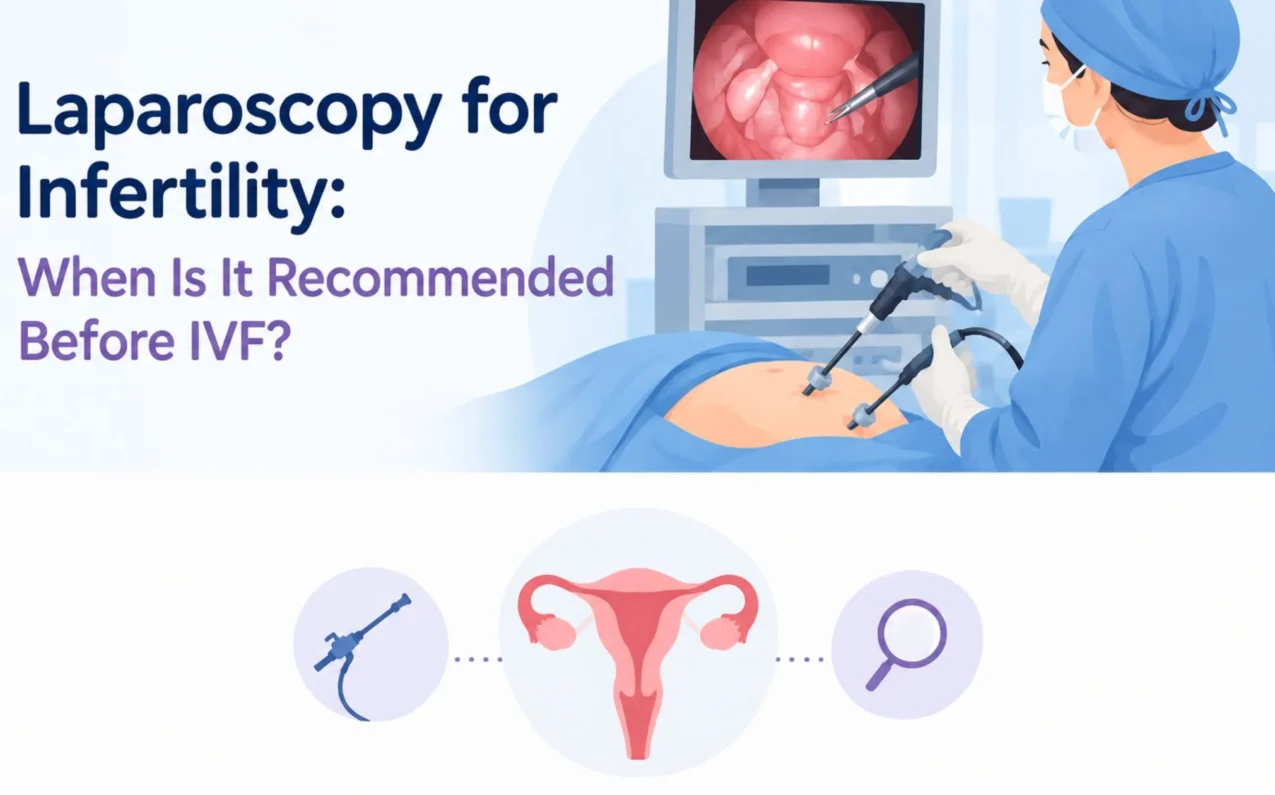
If you are having trouble conceiving, your fertility specialist may recommend several tests before choosing a treatment. One of these tests may be laparoscopy for infertility.
Laparoscopy is a minimally invasive procedure. It allows a doctor to look inside the abdomen and pelvis and check for conditions that may affect fertility.
It is important to know that laparoscopy is not required before IVF for everyone. Your doctor may recommend it when there is a specific reason to look for or treat a fertility problem.
What is laparoscopy for infertility?
Laparoscopy for infertility is a keyhole surgical procedure used to examine and, in some cases, treat problems inside the pelvis. A surgeon uses a thin camera called a laparoscope through a small incision in the abdomen.
The procedure can help identify conditions such as:
- Endometriosis
- Pelvic adhesions or scar tissue
- Certain ovarian cysts
- Fallopian tube problems
- Hydrosalpinx
- Other pelvic abnormalities
During the procedure, the surgeon may also treat some of the problems found.
A dye test called chromopertubation may be performed during laparoscopy. This helps check whether the fallopian tubes are open.
The American Society for Reproductive Medicine notes that diagnostic laparoscopy with chromopertubation can be useful when surgery is already being considered for another reason.
In simple terms, laparoscopy gives your doctor a direct view of the pelvic organs. It can provide information that some routine fertility tests cannot.
When is laparoscopy recommended before IVF?
Laparoscopy before IVF may be recommended when your doctor suspects a condition that could affect fertility or your IVF treatment plan.
Your doctor may recommend this if you have:
- Suspected or confirmed endometriosis
- Ongoing pelvic pain
- Pelvic adhesions
- Certain fallopian tube problems
- Hydrosalpinx
- A history of pelvic infection
- Previous pelvic surgery
- An abnormal finding that needs further investigation
Laparoscopic surgery for infertility is not a routine step for every person undergoing IVF.
Many fertility problems can be investigated using less invasive tests. The NICE fertility guideline updated in 2026 recommends less invasive testing, such as hysterosalpingography or HSG, for assessing tubal blockage in appropriate patients.
Laparoscopy may be considered when there is a specific reason to examine the pelvis directly.
Your age, fertility history, symptoms, ovarian reserve, and previous treatment can all influence the decision.
Can laparoscopy help with blocked fallopian tubes?
Laparoscopy for blocked tubes can help doctors assess and treat selected tubal problems. The right approach depends on where the blockage is and how much the tube has been damaged.
One condition doctors pay particular attention to is hydrosalpinx. This happens when a fallopian tube becomes blocked and fills with fluid.
Hydrosalpinx can reduce the chances of successful IVF. The American Society for Reproductive Medicine recommends considering treatment for certain hydrosalpinges before IVF.
Treatment may include removing the affected tube or blocking it before IVF.
Not every blocked tube requires surgery. Your doctor will consider several factors before recommending treatment.
These factors can include:
- Your age
- Ovarian reserve
- The location of the blockage
- The severity of tubal damage
- Other causes of infertility
- Whether IVF is already planned
The goal is to choose the treatment that offers the best balance between potential benefit and risk.
Is laparoscopy useful for endometriosis and infertility?
Laparoscopy can help diagnose and treat endometriosis, but surgery is not automatically recommended for everyone with endometriosis.
Endometriosis occurs when tissue similar to the uterine lining grows outside the uterus. It can cause pelvic pain and affect fertility.
Laparoscopy allows a surgeon to see endometriosis and pelvic adhesions directly. In selected cases, the surgeon can treat the disease during the same procedure.
The European Society of Human Reproduction and Embryology (ESHRE) states that operative laparoscopy may be considered for some women with stage I or II endometriosis who are trying to conceive.
The decision depends on your individual situation.
Your doctor may consider:
- Your age
- Pain symptoms
- Ovarian reserve
- Previous surgery
- Other causes of infertility
- Your plans for IVF
Surgery for an ovarian endometrioma also needs careful consideration. Removing an endometrioma can sometimes affect ovarian reserve.
Your fertility specialist should therefore discuss the possible benefits and risks before recommending surgery.
What is recovery like after laparoscopy treatment?
Recovery after laparoscopy treatment depends on the type of procedure performed. With a minor procedure, you may be able to get back to your normal activities within a few days.
You may experience:
- Mild abdominal discomfort
- Soreness around the incision
- Tiredness
- Temporary shoulder pain from the gas used during surgery
The American College of Obstetricians and Gynecologists states that recovery varies depending on the procedure. You may be able to get back to your normal activities within 1 to 2 days after a minor procedure.
More extensive laparoscopic surgery can require a longer recovery period.
Your doctor will tell you when you can return to work, exercise, sexual activity, or fertility treatment.
You should contact your doctor if you develop severe pain, fever, heavy bleeding, or signs of infection.
Following your doctor’s recovery instructions can help you return to your normal routine safely.
Can you get pregnant after laparoscopy?
Pregnancy after laparoscopy is possible, but surgery does not guarantee pregnancy.
Your chances depend on the reason for surgery and other factors affecting fertility.
These factors can include:
- Age
- Ovarian reserve
- Sperm health
- Fallopian tube function
- Endometriosis
- Previous fertility treatment
Some women may conceive naturally after a fertility problem has been treated. Others may still need IUI or IVF.
For women with endometriosis, ESHRE recommends considering factors such as age, ovarian reserve, previous surgery, pain, and the likelihood of natural conception when deciding between surgery and assisted reproduction.
The timing of pregnancy attempts after surgery also varies. Your doctor can advise you when it is appropriate to start trying.
If pregnancy does not occur naturally, IVF may still be an option.
Is laparoscopy necessary before IVF?
No. Laparoscopy is not necessary before IVF for every patient.
Many people can start IVF without having laparoscopic surgery.
Doctors usually consider laparoscopy when there is a specific reason to investigate or treat a condition that could affect fertility or IVF treatment.
For example, your doctor may recommend surgery if you have:
- Suspected endometriosis
- Hydrosalpinx
- Significant pelvic adhesions
- Certain tubal abnormalities
- A pelvic condition that requires surgical treatment
The NICE fertility guideline updated in 2026 supports less invasive fertility investigations when they are appropriate.
This means your doctor may recommend IVF directly if your fertility tests do not show a reason for surgery.
Your treatment plan will depend on your individual situation. Your doctor may consider factors such as your age, fertility history, ovarian reserve, tubal health, sperm factors, and any previous treatments.
Laparoscopy or IVF: which comes first?
There is no single answer because laparoscopy and IVF have different purposes.
Laparoscopy is a surgical procedure. It helps doctors diagnose or treat selected pelvic conditions.
IVF is an assisted reproductive treatment. It involves fertilising an egg with sperm in a laboratory and transferring an embryo into the uterus.
| Laparoscopy | IVF |
| Surgical procedure | Fertility treatment |
| Examines the pelvis | Helps achieve pregnancy |
| Can diagnose selected pelvic conditions | Can treat many causes of infertility |
| Can treat some conditions | Does not require the fallopian tubes to transport the embryo |
| May be recommended for a specific medical reason | May be recommended when assisted reproduction is appropriate |
Some people may benefit from surgery before IVF. Others may not need surgery at all.
Your fertility specialist can help you understand which option is appropriate for you.
When should you talk to a fertility specialist?
A fertility specialist can help you decide whether laparoscopy is appropriate for your situation.
You may benefit from a consultation if you have been trying to conceive without success. A consultation can also help if you have endometriosis, suspected tubal problems, previous pelvic surgery, or unexplained infertility.
If your doctor has suggested diagnostic laparoscopy for infertility, ask why the procedure is being recommended. You can also ask how it may affect your fertility treatment plan and whether other tests are available.
At EVA IVF & Women’s Centre, fertility specialists can assess your medical history and discuss suitable fertility treatment options.
Key takeaway
Laparoscopy can be useful for diagnosing and treating selected causes of infertility. It is not a routine requirement before IVF.
The right decision depends on your symptoms, test results, age, ovarian reserve, tubal health, and overall fertility plan.
If you are unsure whether you need laparoscopy before IVF, speaking with a fertility specialist can help you understand your options.
Talk to a Fertility Specialist
If you have been advised to consider laparoscopy or are unsure about the next step in your IVF journey, EVA IVF & Women’s Centre can help you understand your fertility treatment options.