


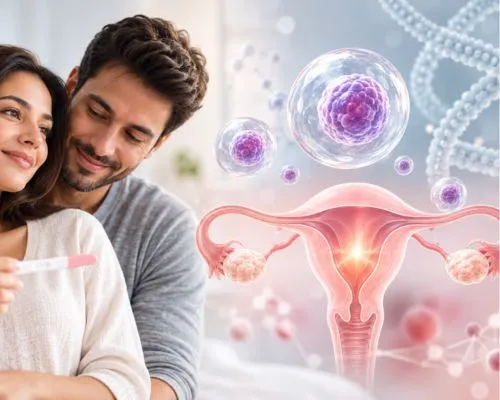
Infertility can be emotionally difficult, especially when pregnancy does not occur despite months of trying or several fertility treatments. Stem cell therapy has gained attention as a possible new approach to reproductive medicine. Researchers are studying whether stem cells could help repair damaged reproductive tissues or improve certain aspects of reproductive function.
Stem cell therapy for infertility is still an experimental approach for many proposed uses. It has not been established as a reliable way to restore fertility or guarantee pregnancy. Understanding the research, potential risks, and available treatment options can help patients make informed decisions.
What Is Stem Cell Therapy for Infertility?
Stem cell therapy for infertility is an investigational approach that studies whether stem cells can support or repair reproductive tissues. Stem cells can develop into certain specialised cell types under specific conditions. Researchers are examining their possible role in ovarian function, uterine health, and male reproductive health.
Stem cells may come from different sources. These include bone marrow, adipose tissue, and other biological materials. Their effects depend on the cell type, preparation method, and treatment being studied.
Researchers are investigating several possible applications:
- Supporting ovarian function in women with certain fertility conditions.
- Studying tissue repair in the uterine lining.
- Examining biological processes involved in sperm production.
- Understanding whether cell-based treatments could support reproductive function.
These applications remain under investigation. Stem cell therapy is not a standard replacement for established fertility treatments such as in vitro fertilisation (IVF).
Can Stem Cell Therapy Help Treat Female Infertility?
Stem cell therapy may have future applications in female infertility, but current research does not establish it as a dependable treatment for achieving pregnancy.
Scientists are studying whether stem cells or their biological signals could influence ovarian tissue, inflammation, blood supply, and cell repair. Much of this work remains at the laboratory or early clinical research stage.
Stem cell therapy for low ovarian reserve
A low ovarian reserve indicates that a woman has fewer eggs remaining in her ovaries than expected for her age. Doctors often assess ovarian reserve using blood tests such as anti-Müllerian hormone (AMH) and antral follicle count through ultrasound.
Scientists are investigating whether treatments using stem cells may help improve or support the way the ovaries work. They have not established that these treatments reliably restore the egg supply or improve live birth rates.
Stem cell therapy for premature ovarian insufficiency
Premature ovarian insufficiency (POI) occurs when ovarian function declines before the age of 40. Scientists are exploring whether new regenerative treatments could help manage this condition.
Stem cell therapy has not been established as a standard treatment for restoring ovarian function in women with POI. Patients should discuss evidence-based fertility options with a reproductive medicine specialist.
How Could Stem Cell Therapy Help in Fertility Care?
The potential benefits of stem cell therapy in fertility treatment are research goals rather than proven clinical outcomes.
Researchers are investigating whether certain cell-based approaches could support tissue repair or influence reproductive processes. The main areas of interest include:
Ovarian research: Studying whether cell-based approaches can influence ovarian tissue and function.
Uterine health: Investigating possible ways to repair damaged endometrial tissue.
Male reproductive health: Studying biological mechanisms linked to sperm production and reproductive function.
Regenerative medicine: Understanding how cells and their signalling molecules may affect tissue repair.
These findings should not be interpreted as proof that stem cell therapy improves pregnancy rates. Improved test results do not necessarily mean that a patient has a greater chance of becoming pregnant or having a baby.
Larger, well-designed clinical studies are needed to establish which treatments may be safe and effective for specific fertility conditions.
What Are the Possible Risks of Stem Cell Treatment for Infertility? Stem cell therapy can carry risks, particularly when the treatment has not been adequately tested or is offered outside appropriate regulatory oversight.
The exact risks depend on the cell source, preparation, delivery method, and the patient’s medical condition. Potential concerns include:
Infection or contamination during cell collection and processing.
Immune or inflammatory reactions.
Tissue damage related to the procedure.
Unintended cell growth or other unexpected biological effects.
Unknown long-term effects.
Financial costs without proven benefits.
The US Food and Drug Administration (FDA) warns that unapproved regenerative medicine products may be unsafe and misleadingly marketed. Its patient guidance describes serious adverse events associated with certain unapproved products. These warnings highlight the importance of checking the evidence and regulatory status of any proposed treatment.
Patients should be cautious about clinics or advertisements that promise guaranteed pregnancy, restored ovarian function, or successful treatment after failed IVF. Such claims require strong clinical evidence.
Stem Cell Therapy vs IVF: What Is the Difference?
Stem cell therapy and IVF are different approaches to fertility care. IVF is an established treatment in which eggs are collected, fertilised in a laboratory, and resulting embryos may be transferred to the uterus. Stem cell therapy for infertility remains investigational for many proposed applications.
| Feature | Stem cell therapy | IVF |
| Main purpose | Investigate possible tissue repair or changes in reproductive function | Assist fertilisation and embryo development |
| Evidence | Varies by application; many approaches remain experimental | Established treatment with evidence-based clinical protocols |
| Clinical status | Depends on the specific treatment and local regulations | Widely available as a recognised fertility treatment |
| Pregnancy outcomes | Not reliably established for many proposed uses | Outcomes vary by age, diagnosis, embryo factors, and other clinical considerations |
| Key consideration | Research evidence, safety, and regulatory oversight | Individual treatment suitability and expected outcomes |
IVF is not guaranteed to result in pregnancy. Its suitability depends on the patient’s diagnosis and clinical circumstances.
Stem cell therapy should not be viewed as a proven alternative to IVF. A fertility specialist can explain established options based on a patient’s medical history and test results.
What Are the Potential Benefits of Stem Cell Therapy in Fertility Treatment?
The potential benefits of stem cell therapy in fertility treatment are research goals rather than proven clinical outcomes.
Researchers are investigating whether certain cell-based approaches could support tissue repair or influence reproductive processes. The main areas of interest include:
- Ovarian research: Studying whether cell-based approaches can influence ovarian tissue and function.
- Uterine health: Investigating possible ways to repair damaged endometrial tissue.
- Male reproductive health: Studying biological mechanisms linked to sperm production and reproductive function.
- Regenerative medicine: Understanding how cells and their signalling molecules may affect tissue repair.
These findings should not be interpreted as proof that stem cell therapy improves pregnancy rates. A change in a laboratory marker or tissue measurement does not automatically mean that a patient has a higher chance of having a baby.
Larger, well-designed clinical studies are needed to establish which treatments may be safe and effective for specific fertility conditions.
What Are the Risks of Stem Cell Therapy for Infertility?
Stem cell therapy can carry risks, particularly when the treatment has not been adequately tested or is offered outside appropriate regulatory oversight.
The exact risks depend on the cell source, preparation, delivery method, and the patient’s medical condition. Potential concerns include:
- Infection or contamination during cell collection and processing.
- Immune or inflammatory reactions.
- Tissue damage related to the procedure.
- Unintended cell growth or other unexpected biological effects.
- Unknown long-term effects.
- Financial costs without proven benefits.
The US Food and Drug Administration (FDA) warns that unapproved regenerative medicine products may be unsafe and misleadingly marketed. Its patient guidance describes serious adverse events associated with certain unapproved products. These warnings highlight the importance of checking the evidence and regulatory status of any proposed treatment. <Cite refs={[“turn652605search0″,”turn652605search1”]}/>
Patients should be cautious about clinics or advertisements that promise guaranteed pregnancy, restored ovarian function, or successful treatment after failed IVF. Such claims require strong clinical evidence.
Stem Cell Therapy vs IVF: What Is the Difference?
Stem cell therapy and IVF are different approaches to fertility care. IVF is an established treatment in which eggs are collected, fertilised in a laboratory, and resulting embryos may be transferred to the uterus. Stem cell therapy for infertility remains investigational for many proposed applications.
| Feature | Stem cell therapy | IVF |
| Main purpose | Investigate possible tissue repair or changes in reproductive function | Assist fertilisation and embryo development |
| Evidence | Varies by application; many approaches remain experimental | Established treatment with evidence-based clinical protocols |
| Clinical status | Depends on the specific treatment and local regulations | Widely available as a recognised fertility treatment |
| Pregnancy outcomes | Not reliably established for many proposed uses | Outcomes vary by age, diagnosis, embryo factors, and other clinical considerations |
| Key consideration | Research evidence, safety, and regulatory oversight | Individual treatment suitability and expected outcomes |
IVF is not guaranteed to result in pregnancy. Its suitability depends on the patient’s diagnosis and clinical circumstances.
Stem cell therapy should not be viewed as a proven alternative to IVF. A fertility specialist can explain established options based on a patient’s medical history and test results.
Is Stem Cell Therapy for Infertility Approved?
Approval depends on the exact product, intended use, clinical evidence, and country where treatment is offered. There is no single approval status that applies to every stem cell-based procedure.
In the United States, the FDA states that approved stem cell products are limited to specific uses involving blood-forming cells. These approvals do not establish stem cell therapy as an approved treatment for infertility. <Cite refs={[“turn652605search0″,”turn652605search1”]}/>
Patients considering treatment in India or another country should check the applicable national regulations and the status of the specific procedure. A treatment being advertised by a clinic or listed in a clinical trial database does not, by itself, prove that it is approved or effective.
Before enrolling in a study, patients should ask about the research protocol, independent ethics review, known risks, costs, and the evidence supporting the treatment.
What Are the Current Alternatives to Stem Cell Therapy?
Patients experiencing infertility have established options that depend on the cause of the problem. A fertility specialist usually recommends an assessment before selecting treatment.
Possible options include:
- Ovulation treatment: May help when ovulation disorders affect conception.
- Intrauterine insemination (IUI): Places prepared sperm inside the uterus around ovulation in suitable cases.
- In vitro fertilisation (IVF): Combines eggs and sperm in a laboratory.
- Intracytoplasmic sperm injection (ICSI): Injects a single sperm into an egg during an IVF cycle when indicated.
- Fertility preservation: Egg, sperm, or embryo freezing may be suitable for some people who want to preserve future reproductive options.
Not every treatment suits every patient. The choice depends on factors such as age, ovarian reserve, sperm health, fallopian tube function, medical history, and previous treatment outcomes.
The World Health Organization published an evidence-based infertility guideline on 28 November 2025. It provides recommendations for evaluating and treating infertility across several clinical situations. <Cite refs={[“turn652605search6”]}/>
Frequently Asked Questions About Stem Cell Therapy for Infertility
Researchers are investigating this possibility, but stem cell therapy has not been proven to reliably restore ovarian function or the supply of eggs.
Researchers are studying stem cell approaches to male reproductive conditions. These methods are not established routine treatments for restoring sperm production.
Safety depends on the exact treatment and how it is delivered. Experimental procedures may have unknown risks. Patients should verify regulatory status and understand the available safety evidence before proceeding.
A failed IVF cycle does not automatically mean that stem cell therapy is the next appropriate option. A specialist can review previous cycles, identify possible factors affecting outcomes, and explain evidence-based alternatives.
New developments in reproductive medicine can offer reasons for hope, but patients deserve clear information about what research has and has not established.
If you are considering stem cell therapy for infertility, speak with a qualified fertility specialist before making a decision. Ask about the scientific evidence, potential risks, regulatory status, and established alternatives relevant to your diagnosis.
EVA Fertility Clinic encourages patients to seek individual medical guidance when evaluating fertility treatment options. A consultation can help you understand the available approaches and make an informed decision based on your reproductive health needs.
Medical disclaimer: This article is for educational purposes only. It does not replace medical advice, diagnosis, or treatment from a qualified healthcare professional.
